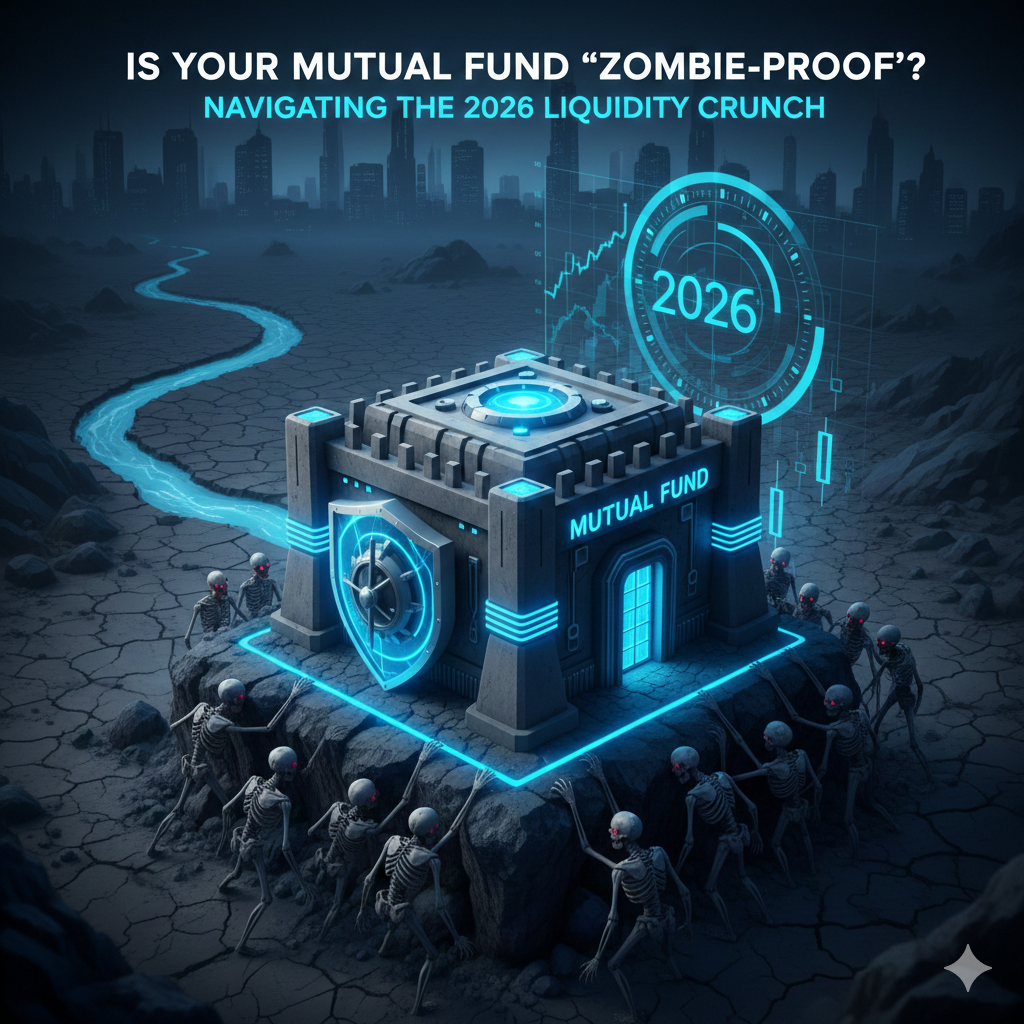
In the financial world of 2026, the term “zombie” has moved from cinema screens to brokerage statements. As of early this year, nearly one in five U.S. public companies is classified as a “zombie”—a firm that earns just enough to service its debt but cannot pay down the principal or invest in growth.
While these companies shuffle along on life support, they pose a hidden threat to your portfolio. The “Great Liquidity Crunch of 2026” is no longer a forecast; it is a reality hitting mutual funds that stayed too long in low-quality, high-leverage positions.
In this guide, you will learn how to identify if your mutual fund is “zombie-proof,” why active management is the only antidote in 2026, and the specific metrics you need to safeguard your retirement.
Table of Contents
- The 2026 Zombie Apocalypse: A Financial Reality Check
- What is the 2026 Liquidity Crunch?
- Red Flags: How to Spot a “Zombie-Heavy” Fund
- Active vs. Passive: Why Index Funds Are Vulnerable
- The “Zombie-Proof” Checklist for Investors
- Expert Strategies for Portfolio Resilience
- Frequently Asked Questions (FAQ)
1. The 2026 Zombie Apocalypse: A Financial Reality Check
The number of U.S. zombie companies has surged to over 640 firms in the Russell 3000 index alone. These businesses are the “walking dead” of the stock market. Propped up by years of cheap pandemic-era debt, they are now hitting a “maturity wall” as they struggle to refinance at 2026’s higher interest rates.
When a mutual fund holds these companies, it isn’t just holding “value” stocks; it is holding a ticking time bomb. If a few of these companies default simultaneously, it triggers a chain reaction known as a liquidity event.
2. What is the 2026 Liquidity Crunch?
A liquidity crunch occurs when a mutual fund faces a surge in redemptions (investors selling their shares) but cannot sell its underlying stocks quickly enough to pay them.
In 2026, the problem is compounded by the “Zombie Factor.” High-quality stocks are easy to sell. Zombie stocks are not. If a fund is forced to sell its “good” stocks to cover redemptions, the remaining investors are left holding a concentrated pile of “toxic” zombie assets.
Why 2026 is Different:
- The Refinancing Wall: Trillions in corporate debt are coming due this year. Companies that can’t pay are facing “sudden-death” bankruptcies.
- NBFI Interconnectedness: As noted by the Bank for International Settlements (BIS), non-bank financial intermediaries (like mutual funds) are more interconnected than ever, meaning a spark in one fund can start a fire in yours.
3. Red Flags: How to Spot a “Zombie-Heavy” Fund
You don’t need a Bloomberg terminal to protect yourself. You just need to look for these three red flags in your fund’s prospectus:
- High Concentration in “CCC” Rated Debt: If your income or bond fund has moved down the quality ladder to chase yield, you are likely exposed to zombies.
- The “Interest Coverage” Gap: Look at the fund’s top 10 holdings. If those companies have an Interest Coverage Ratio (EBIT/Interest Expense) below 1.5x, they are in the danger zone.
- Stagnant Revenue Growth: A true zombie company isn’t growing. If your fund is filled with companies showing less than 3% sales growth over three years, it’s a “Zombie Fund.”
4. Active vs. Passive: Why Index Funds Are Vulnerable
For a decade, passive index funds were the “safe” bet. But in 2026, passive funds are forced by their own rules to own everything in the index—including the zombies.
Active Management has become the ultimate filter. A skilled active manager uses the “Human Premium” to perform deep-dive credit analysis that an algorithm might miss. They can “prune the dead wood” before a company hits the wall.
“In a 2026 market defined by dispersion, the ability to say ‘no’ to a stock is more valuable than the ability to buy one.” — Financial Insights 2026.
5. The “Zombie-Proof” Checklist for Investors
Follow this step-by-step checklist to evaluate your current holdings. Use free tools like Google Finance or Yahoo Finance to check the stats of the fund’s top holdings.
- [ ] Check the “Active Share”: Is your manager actually making choices, or just mimicking the index? (Look for an Active Share > 70%).
- [ ] Verify Cash Levels: Does the fund hold at least 3–5% in cash or cash equivalents to handle sudden redemptions?
- [ ] Analyze Debt-to-Equity: Ensure the fund’s median debt-to-equity ratio hasn’t spiked over the last 12 months.
- [ ] Review the “Altman Z-Score”: This is a classic formula used to predict bankruptcy. A score below 1.8 is a major warning sign.
6. Expert Strategies for Portfolio Resilience
To stay “Zombie-Proof” in the 2026 liquidity crunch, professionals are shifting their strategy from growth to quality.
Focus on “Real Cash Flow”
In 2026, EBITDA is a “fairytale.” Focus on Free Cash Flow (FCF). Companies that generate actual cash after expenses can survive without the mercy of the credit markets.
Thematic Diversification
Rotate into sectors that are “anti-zombie” by nature—such as Infrastructure, Utilities, and Healthcare. These sectors are supported by the OBBBA (One Big Beautiful Bill Act) and have more stable, regulated revenue streams.
7. Frequently Asked Questions (FAQ)
Q: What exactly is a “Zombie Company” in 2026?
A: It is a firm that has interest-coverage ratios below one for at least three consecutive years. They effectively “walk” but cannot run or grow.
Q: Can a mutual fund “go bankrupt”?
A: Not in the traditional sense, but it can “gate” redemptions—meaning they stop you from taking your money out—or its Net Asset Value (NAV) can plummet if it’s forced to sell assets at a loss.
Q: Is there a free tool to check for zombie stocks?
A: Yes. You can use Google Search Console data to find trending reports on “delisting risks” or use Ubersuggest to find which companies are seeing spikes in “bankruptcy” searches.
Conclusion: Don’t Wait for the “Crash”
The 2026 Liquidity Crunch is a selective crisis. It won’t take down the whole market, but it will devour the “Zombies” and the funds that hold them. By choosing quality over yield and active management over blind indexing, you can ensure your portfolio remains “Zombie-Proof.”
Is your portfolio ready for the next wave of corporate defaults?
I can help you analyze the specific liquidity terms of your mutual fund category. Would you like me to generate a “Safety Scorecard” for the top 5 most popular mutual fund categories of 2026?